Salt is one of the flavor enhancers in cooking that complements our food. But the taste of food can change depending on the time of putting salt while cooking, either before, during, or after putting it.
It is common knowledge that salt tastes salty, but it gives its flavor to dishes as described by the chemist, Fatimah Salim. She said, salt is composed of sodium crystals (sodium, Na) and also chlorine (chlorine, Cl).
The salty taste formed is the interaction of Na + ions with the sense of salty taste on the tongue. That is, no matter what salt you use, the salinity of food depends on the number of sodium ions in it.
According to a post by Fatimah Salim on Facebook, there are a few things that people needs to know about the effects of salt in cooking. Below are her full statement:
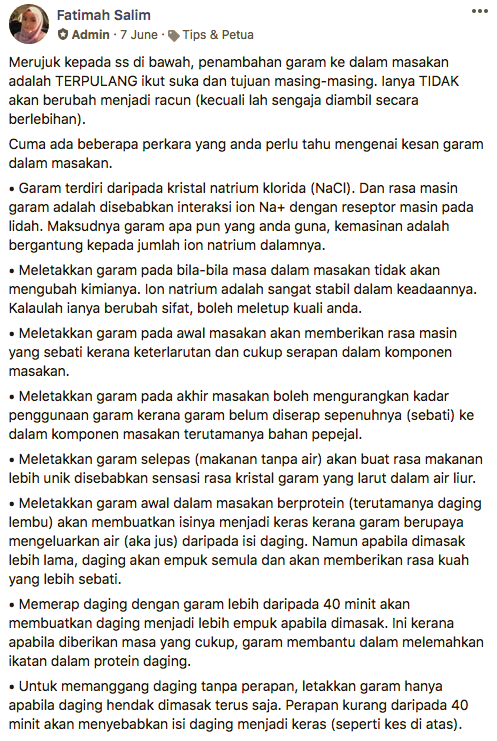
Referring to the screenshot below, the addition of salt into a dish is depends on purpose of each of you. It will NOT turn into poison (unless it is taken in excess).
There are just a few things you need to know about the effects of salt in cooking.
• Salt consists of sodium chloride (NaCl) crystals. And the salty taste of salt is due to the interaction of Na + ions with saline receptors on the tongue. This means that whatever salt you use, salinity depends on the number of sodium ions in it.
• Putting salt at any time in cooking will not change its chemistry. Sodium ions are very stable in their state. If it changes properties, it can explode your pan.
• Putting salt at the beginning of cooking will give a salty taste due to its solubility and adequate absorption in the cooking components.
• Putting salt at the end of cooking can reduce the rate of salt consumption because salt has not been fully absorbed (blended) into the cooking components, especially solid ingredients.
• Putting salt after (food without water) will make the food taste more unique due to the sensation of salt crystals dissolved in saliva.
• If you put salt in protein dishes such as beef, it will make the meat hard because salt is able to remove water / juice from the meat as a result of the reaction that occurs. However, if this hard meat is cooked longer, the meat will be tender again and will give a more well-balanced gravy.
• Marinating the meat with salt for more than 40 minutes can make the meat softer when cooked. This is because the time given is enough to help weaken the bonds in the meat protein, thereby making the meat soft.
•For grilling meat without marinate, it is enough to add salt when the meat is to be cooked directly. Marinating meat for less than 40 minutes can cause the meat to harden.
Sources: Fatimah Salim