
Malaysia’s base electricity tariff is rising by approximately 14% under Regulatory Period 4. This increase, to 45.62 sen/kWh, marks the first hike in over a decade.
The national carbon tax confirmed in Budget 2026 will target heavy industry. As a result, Malaysian manufacturers now face unprecedented pressure to control their energy costs. One Klang-based engineering firm decided not to wait.
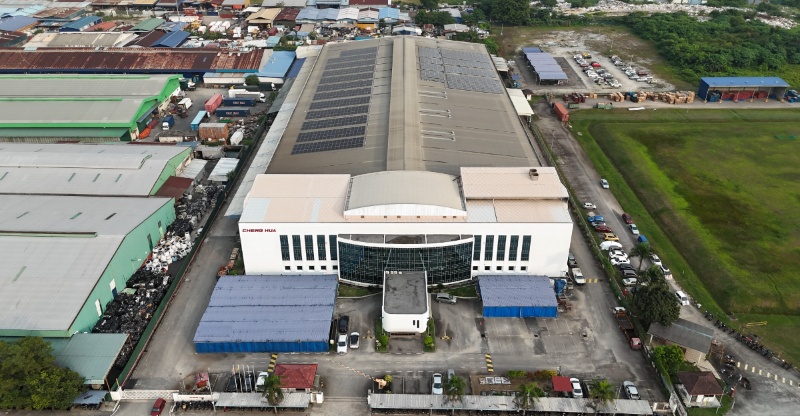
EFS Group is a leading provider of renewable energy and energy efficiency solutions. The company has completed a 403 kWp rooftop solar installation. It is located at Cheng Hua Engineering Works Sdn Bhd’s Klang facility. The results were immediate.
In its first full month of operation, the system delivered nearly a 50% reduction in electricity costs. It also offset approximately 30% of the facility’s total electricity consumption.
The system will generate around 362,280 kWh of clean energy annually. It will also reduce Cheng Hua Engineering’s carbon footprint by an estimated 400 metric tonnes each year.
“In today’s climate, energy resilience directly impacts profitability. Companies that act decisively are not only reducing emissions, but they are also strengthening their balance sheets,” said Mr Darren Tan, Chief Executive Officer of EFS Group.
Regulatory Pressures Are Shaping Decisions
The timing is deliberate. Malaysia’s new RP4 tariff structure, effective July 2025, introduces significant increases for industrial low-voltage users.
The low-voltage industrial energy charge rates now range from 48.08 to 52.17 sen/kWh. Previously, these rates were lower, according to the Socio-Economic Research Centre.
For energy-intensive operations like precision engineering, the monthly bill impact is material – and ongoing, as the new Automatic Fuel Adjustment (AFA) mechanism means tariffs now adjust monthly rather than every six months.
Beyond tariffs, the regulatory horizon is sharpening. Malaysia’s Budget 2026 confirmed the country’s first carbon tax – initially targeting the iron, steel, and energy sectors with implementation set for 2026.
Although authorities have not yet officially announced the specific tax rate, they have clearly set the direction of policy. Separately, Malaysian exporters face growing pressure from the EU’s Carbon Border Adjustment Mechanism (CBAM).
For manufacturers with exposure to European supply chains, demonstrating a credible decarbonisation record is rapidly becoming a commercial prerequisite.
Long-Term Strategy, Solar as a Competitive Advantage
Cheng Hua Engineering is not a newcomer to solar. The company first adopted the technology in 2014 under Malaysia’s Feed-in Tariff (FiT) programme, making this latest expansion under the Self-Consumption (SelCo) a mark of a decade-long track record, not a leap of faith.
Crucially, the company fully funded the installation itself, showing that management trusts solar as a bankable, long-term asset rather than just an ESG checkbox.
“Solar has proven its reliability over the past decade, and this expansion allows us to take greater control of our energy consumption while aligning with Malaysia’s low-carbon ambitions,” said Mr Lim Chee Keong, Chief Executive Officer of Cheng Hua Engineering Works Sdn. Bhd.
The Klang project reinforces EFS Group’s position as a clean energy partner for Malaysian manufacturers navigating an increasingly complex energy and regulatory landscape.
Malaysia’s National Energy Transition Roadmap (NETR) sets ambitious targets of 31% renewable energy capacity by 2025, 40% by 2035, and 70% by 2050 and the window for early industrial adopters to gain competitive advantage is narrowing.
“Those who act now are not just reducing emissions. They are building the competitive infrastructure for the next decade of Malaysian manufacturing,” concluded Mr Darren Tan.