The Orion Crew Module isn’t just a spacecraft; it’s the heart of NASA’s historic Artemis II mission. As the first crewed vehicle to venture toward the Moon in over 50 years, Orion is a masterclass in survival, designed to keep four humans alive farther from Earth than ever before.
The Crew Module: Life in 330 Cubic Feet
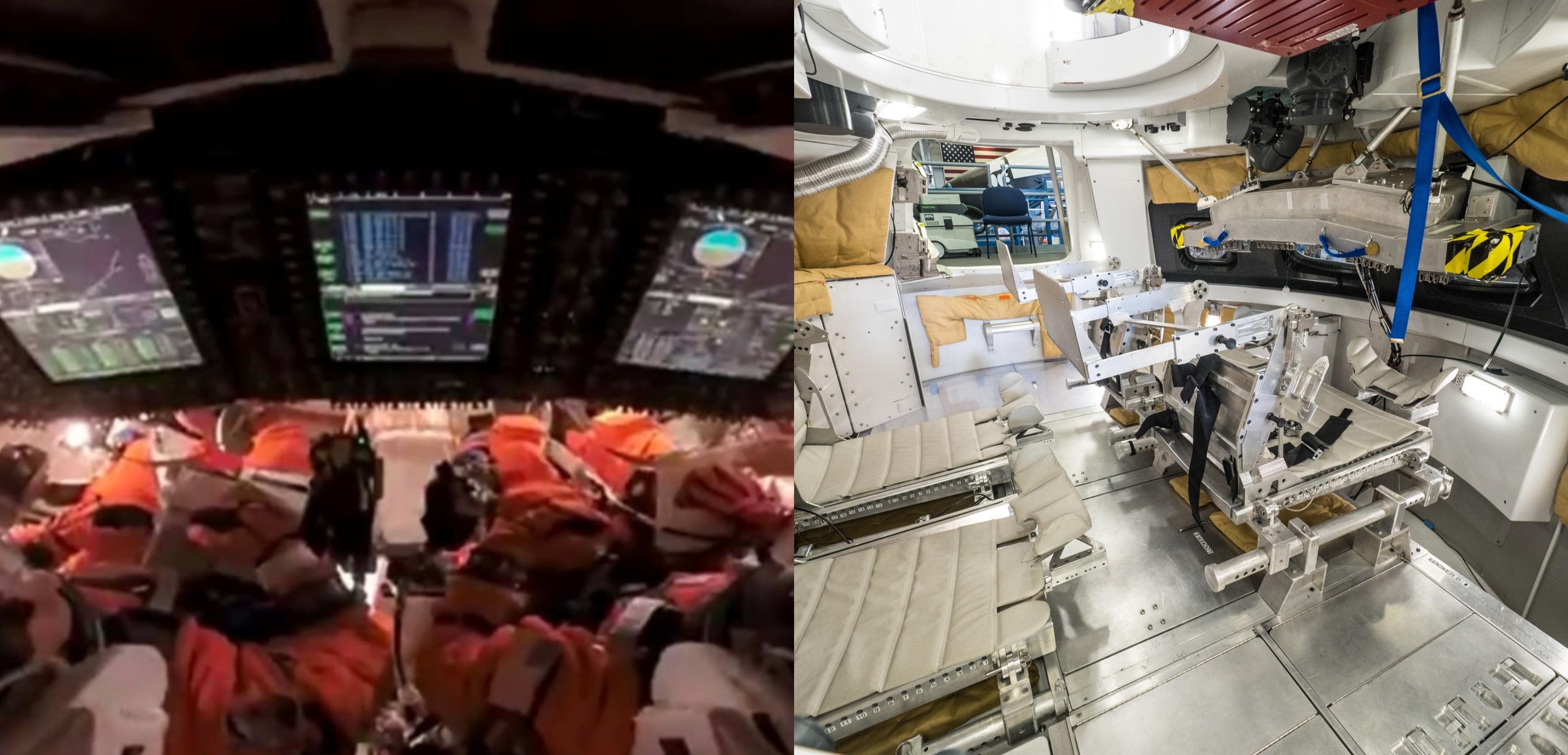
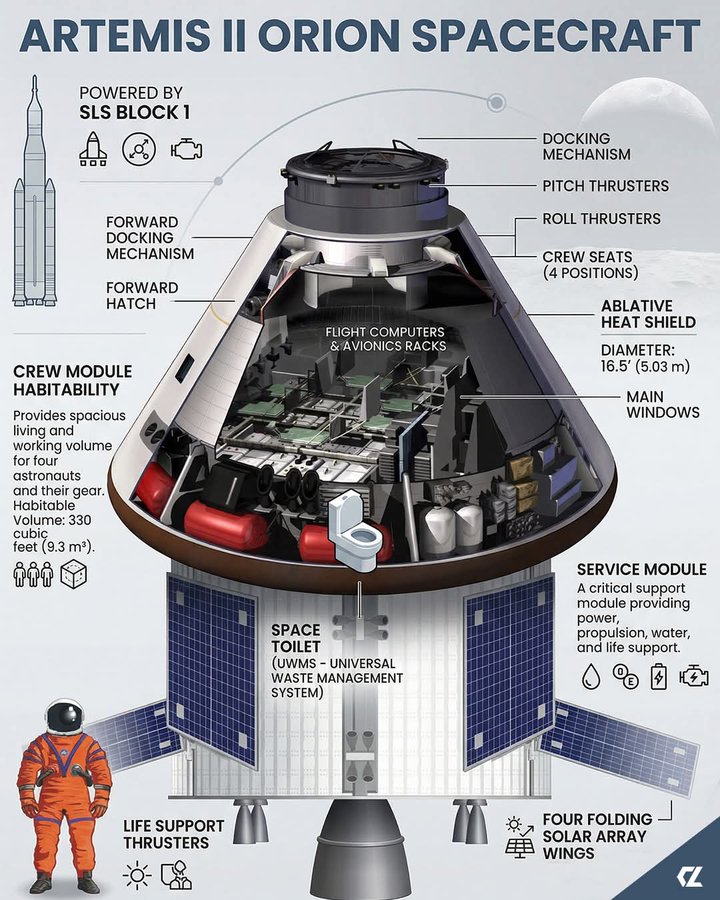
While Orion looks sleek and imposing from the outside, the interior is an exercise in extreme minimalism. The “cockpit” and living quarters are one and the same a shared 330-cubic-foot cabin.
To put that in perspective, the four-person team is living in a space roughly the size of a large SUV. Within these cramped quarters, the crew must meticulously coordinate every move to work, sleep, and exercise. Every inch is mission-critical:
- Impact Seats: Four adjustable seats protect the astronauts from the jarring g-forces of launch and the 20-G “skip” of re-entry.
- The Brains: State-of-the-art flight computers handle complex deep-space navigation that would have been science fiction during the Apollo era.
- The “Space Plumber’s” Challenge: The Universal Waste Management System (UWMS) a high-tech suction toilet uses airflow to manage biology in zero gravity. (It’s already proven its complexity, requiring a quick “prime” from the crew during the current mission!)
🚀 Así es el baño de Artemis II por dentro
🚻 La astronauta Christina Koch muestra cómo funciona uno de los sistemas más curiosos y esenciales de la nave pic.twitter.com/Z7UmeWuTF8— AstroAventura (@AstroAventura) April 3, 2026
View this post on Instagram
The Service Module: The Powerhouse
Orion doesn’t travel alone. It is physically mated to the ESA’s European Service Module (ESM), the spacecraft’s literal “life support engine room.” This powerhouse provides:
- Vital Supplies: All the water and breathable air for the 10-day journey.
- Solar Power: Four iconic “X-wing” solar arrays that generate electricity.
- Propulsion: The primary engine that performed the critical “Lunar Free Return” burn, ensuring the crew could loop around the Moon and head safely back to Earth.
The Return: The Ultimate Shield
Coming home is the most dangerous leg of the trip. To survive the plunge into Earth’s atmosphere, Orion relies on a 16.5-foot ablative heat shield.
As the capsule hits the air at 25,000 mph, friction generates temperatures reaching 2,760°C. The shield is designed to slowly burn away, a process called ablation, which carries the searing heat away from the cabin. This allows the astronauts to safely splash down in the Pacific, transitioning from a high-speed inferno to a gentle float in a matter of minutes.
NASA’s Orion is more than just a vehicle it is a self-contained world that has officially bridged the gap between our home planet and the deep-space frontier.
Sources: SPACE, NASA, LEONARD DAVID’S INSIDE OUTER SPACE, POPULAR SCIENCE, CBS NEWS