
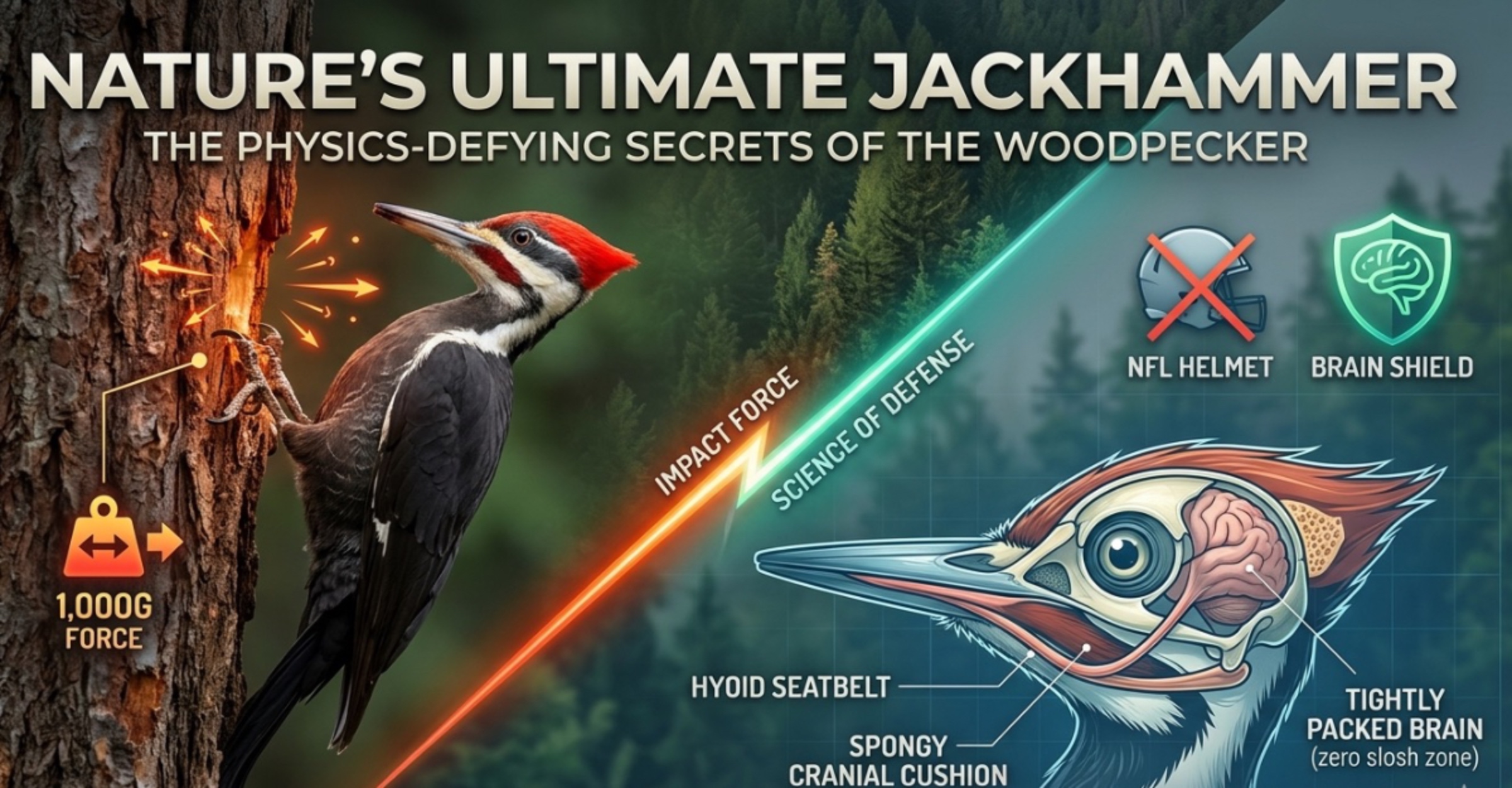
If a human tried to headbutt a tree at 20 hits per second, it wouldn’t just be painful, it would be fatal. Yet, for a woodpecker, this is just a standard Tuesday morning ritual. While the NFL spends millions on helmet technology, nature has already engineered a “super-soldier” of the bird world that can withstand forces that would liquefy a human brain.
The 1,400G Impact: Breaking the Laws of Physics
To understand the woodpecker’s power, you have to look at the numbers. A human fighter pilot blackouts at 9g. A severe car crash occurs at 100g. According to the Journal of Experimental Biology, a woodpecker strikes a tree with a deceleration of up to 1,400g.
So, why don’t they get concussions? It’s not just luck; it’s a masterclass in bio-inspired engineering.
1. The “Scaling Law” (Why Size Matters)
Research from MIT’s Department of Materials Science reveals that the woodpecker’s secret weapon is actually its small size. Because their brains are tiny (roughly 2 grams), they follow the “Scaling Law.” The ratio of the brain’s surface area to its mass is so high that the impact is distributed much more effectively than in a large human brain. In short: the smaller the brain, the more “G-force” it can handle.
2. The Hyoid “Seatbelt”
The most metal thing about a woodpecker isn’t its beak, it’s its tongue. A study published in PLOS ONE used micro-CT scans to show that the woodpecker’s tongue (the hyoid apparatus) actually wraps all the way around the back of its skull, through the nasal cavity, and attaches between the eyes.
The Science: This structure acts as a biological safety harness, storing and dissipating kinetic energy before it ever reaches the brain.
3. The “Cranial Cushion” & Zero Slosh
Unlike human skulls, which are relatively uniform, a woodpecker’s skull is built like a high-end sports car’s “crumple zone.”
- The Spongy Bone: Engineers at Beihang University found that woodpeckers have a porous, spongy bone structure at the base of their beak that acts as a natural shock absorber.
- Zero Displacement: Humans get concussions because our brains “slosh” in cerebrospinal fluid. Woodpeckers have almost no fluid around their brain. It is packed so tightly that there is no room for the brain to move, meaning it never hits the inside of the skull.
The “Tongue-Twisting” Harpoon
Beyond protection, that legendary tongue is a high-speed extraction tool. Sticky, barbed, and driven by powerful neck muscles, it can reach deep into timber to “harpoon” insects. It is a stunning example of an integrated design, where one organ serves as both a weapon for food and a shield for survival.
Sources: MIT News, PLOS ONE, The Journal of Experimental Biology, Harvard University