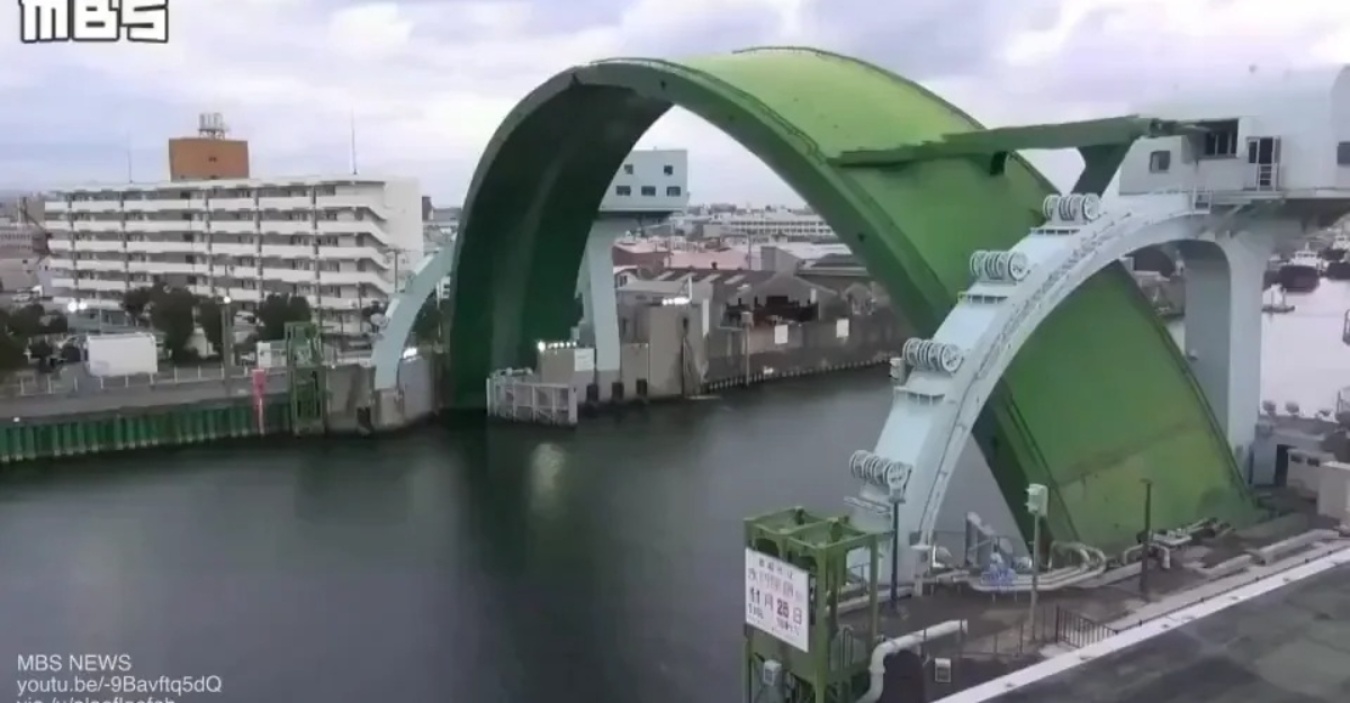
In Osaka. one of Japan‘s busiest urban hubs, a massive engineering system quietly stands guard. While they look like something pulled from a futuristic film, these arched floodgates are the city’s primary defense against one of nature’s most destructive forces: the storm surge.
Built for Extreme Weather
Because of its intricate river system and coastal proximity, Osaka is exceptionally vulnerable to rising sea levels. During a major typhoon, seawater can be forced inland, threatening to submerge entire neighborhoods. To combat this, engineers developed a series of massive revolving barriers that act as a “lock” between the ocean and the city’s veins.
How the System Works
Under blue skies, the gates remain open, allowing ships and water to flow freely. However, when a typhoon warning is issued, these hundreds-of-tons structures rotate downward, sealing off the rivers.
The iconic arched design isn’t just for show, it is a masterpiece of structural integrity. By distributing the massive pressure of incoming waves evenly across the curve, the gates can withstand forces that would buckle a flat wall.
Unique arched floodgates protect from typhoons and storm surges in Osaka, Japan pic.twitter.com/I5uTp0ICf5
— Massimo (@Rainmaker1973) April 15, 2026
Precision at Scale
Despite their gargantuan weight, these gates move with the precision of a Swiss watch. They are designed to activate the moment extreme weather strikes, transforming Osaka from a vulnerable coastal port into a fortified fortress in minutes.
A Global Blueprint
As climate change increases the frequency of extreme weather, Osaka’s floodgates have become a global model for urban resilience. They prove that with forward-thinking design, a city can transform its greatest vulnerability into its strongest defense.